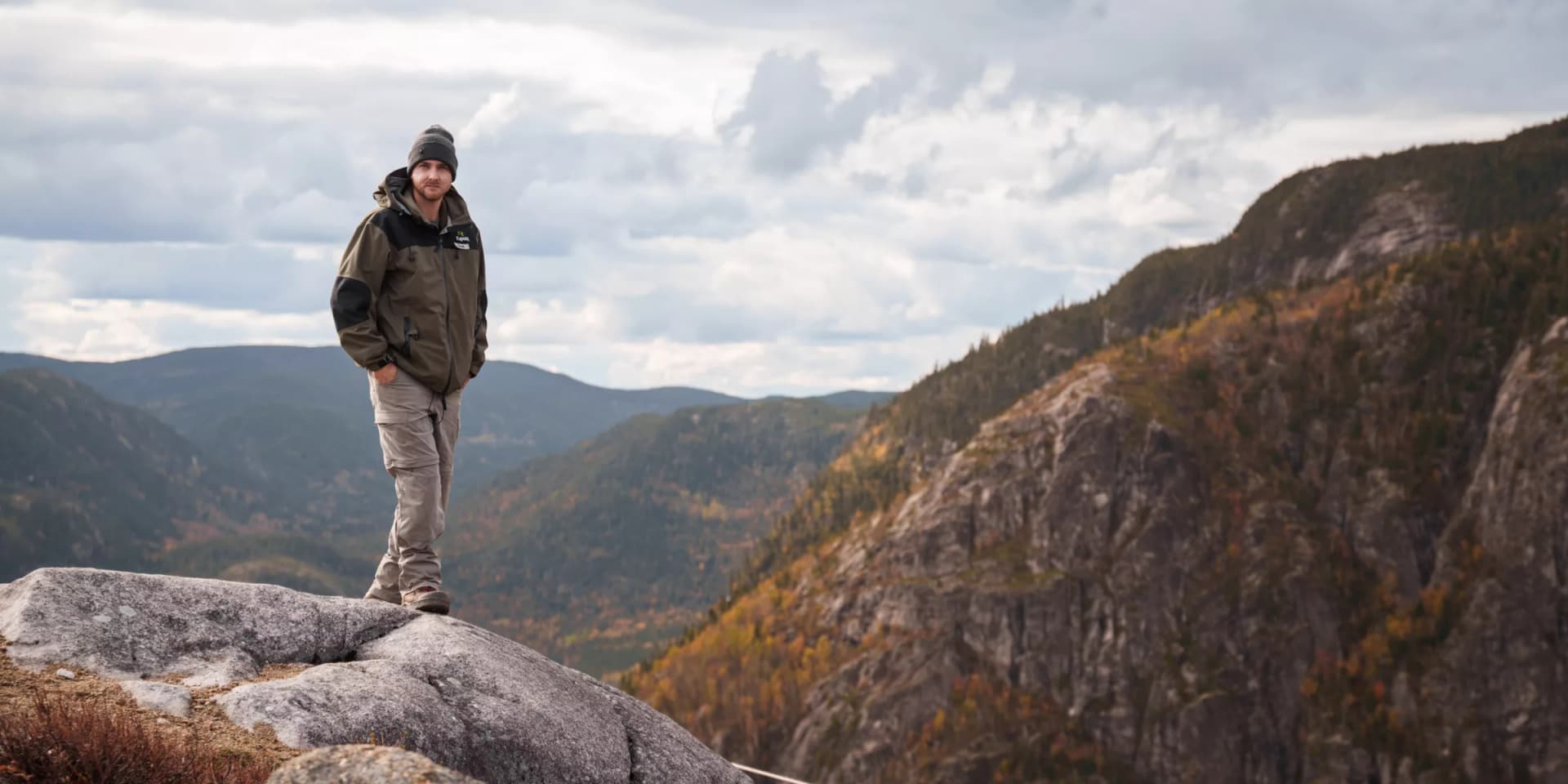
Grands-Jardins National Park, southern taiga and caribou habitat, is one of Charlevoix's great wild spaces above Baie-Saint-Paul. Trails and tips.
To understand the geography of Charlevoix, you need a bit of altitude. Above Baie-Saint-Paul, Route 381 climbs steadily, crosses the inland villages, then opens onto a plateau where the forest suddenly changes face — sparser black spruce, lichen carpets, mossy soils. This is the entrance to Grands-Jardins National Park, one of the great wild spaces of southern Quebec. The park sits about an hour from La Malbaie — a reasonable distance for a day of hiking with a return by evening.
A southern taiga below the 48th parallel
Grands-Jardins covers 319 km² and protects an ecosystem rare at this latitude: a southern taiga, the kind of landscape usually associated with subarctic regions. Expect sparse black-spruce forests, lichen carpets, deep-set lakes, and bare summits where the vegetation takes on the look of alpine tundra. The park forms one of the core zones of the Charlevoix World Biosphere Reserve, recognized by UNESCO — a status earned through the rare combination of landscapes and biodiversity the region offers.
Created in 1981, the park is managed by SÉPAQ. The access road passes through Saint-Urbain from Baie-Saint-Paul and climbs to the welcome station — the park's average elevation tops 700 metres, which explains the cooler climate and shifted seasons. Mid-May to mid-October is the open window for trails; in June, snow patches can still linger on the summits.
Mont du Lac-des-Cygnes: the signature panorama
The park's flagship trail, and one of the most emblematic in Charlevoix, climbs to the top of Mont du Lac-des-Cygnes — 980 metres, a 360-degree view of the region's mountains and, in clear weather, of the Saint Lawrence River below. The trail runs roughly 8 km round trip with 430 metres of elevation gain. SÉPAQ rates it as difficult.
The ascent is not technical, but it is sustained. The final five hundred metres alternate wooden walkways and long staircases — an arrangement that protects the fragile summit vegetation while making the climb manageable. The reward at the top is one of the most complete views in Charlevoix: the Massif mountains to the southeast, the Gouffre valley, and the Laurentians stretching northwest. For many visitors, this is the moment when the region's geography — an impact crater carved out 400 million years ago — becomes visible at a glance.
Other trails, other rhythms
The park has more than thirty kilometres of trails, and Mont du Lac-des-Cygnes is not the only point of interest. La Pinède is a short interpretation walk — under two kilometres — covering the boreal forest and caribou habitat. It is the right option for families, beginner hikers, or anyone who wants to balance a tougher day with a gentle walk before or after.
The Pioui trail offers a medium-difficulty loop through different park environments, from transition forest to clearings. Mont de l'Ours, shorter but steep, gives a second panoramic option for return visitors who want to avoid the high-season traffic of Mont du Lac-des-Cygnes. For visitors wanting to extend the experience to other summits, our guide to the best hikes in Charlevoix maps the other peaks in the region.
Wildlife, flora and caribou
Grands-Jardins was created in part to protect a herd of woodland caribou — the southernmost in Quebec. The La Pinède trail devotes much of its interpretive content to this animal, whose presence is rare and whose health is fragile. Spotting a caribou while hiking is unlikely, but the entire ecosystem — lichens grazed by the animal, sparse forest that serves as habitat, natural predators — carries the imprint of this flagship species.
The park's flora deserves attention of its own. Bare summits host miniature alpine species — dwarf birch, blueberries, varied lichens. The tundra carpet you cross at the top of Mont du Lac-des-Cygnes is protected by the walkways SÉPAQ has installed; stepping off the trail damages vegetation that takes decades to recover. The rule of walking only on the boardwalks is not symbolic.
Practical: access, lodging and tips
The main welcome station sits on Route 381, about an hour from Cap-à-l'Aigle. Daily access fees are collected by SÉPAQ — current pricing and seasonal hours should be confirmed on the official site. Pack water (trails have no resupply points), layers for altitude (summits can be windy and cool even in summer), and sturdy shoes for rocky sections.
For those building two full days outdoors, the neighbouring park — Hautes-Gorges-de-la-Rivière-Malbaie — offers a very different landscape (canyon, river, vertical walls). The two parks together make an excellent base for a nature stay in Charlevoix. On gentler days, the region also reveals itself through its geology — our piece on the Charlevoix astrobleme observatory explains the crater visible from the park's summits. For visitors travelling with children, the Charlevoix family activities guide suggests shorter trails.
The return to La Malbaie in the late afternoon follows Route 138 then 362. After a day above 900 metres, the contrast of lower altitude and the river's edge is precisely what hikers come for — the transition between the taiga and the Saint Lawrence shoreline happens in less than ninety minutes of driving, and that is one of the most striking features of a Charlevoix stay.
To rent a luxury chalet in La Malbaie (Cap-à-l'Aigle), Charlevoix, discover the Le Littoral chalet with heated pool, sauna and spa. Book your stay online or call 418-476-1442.