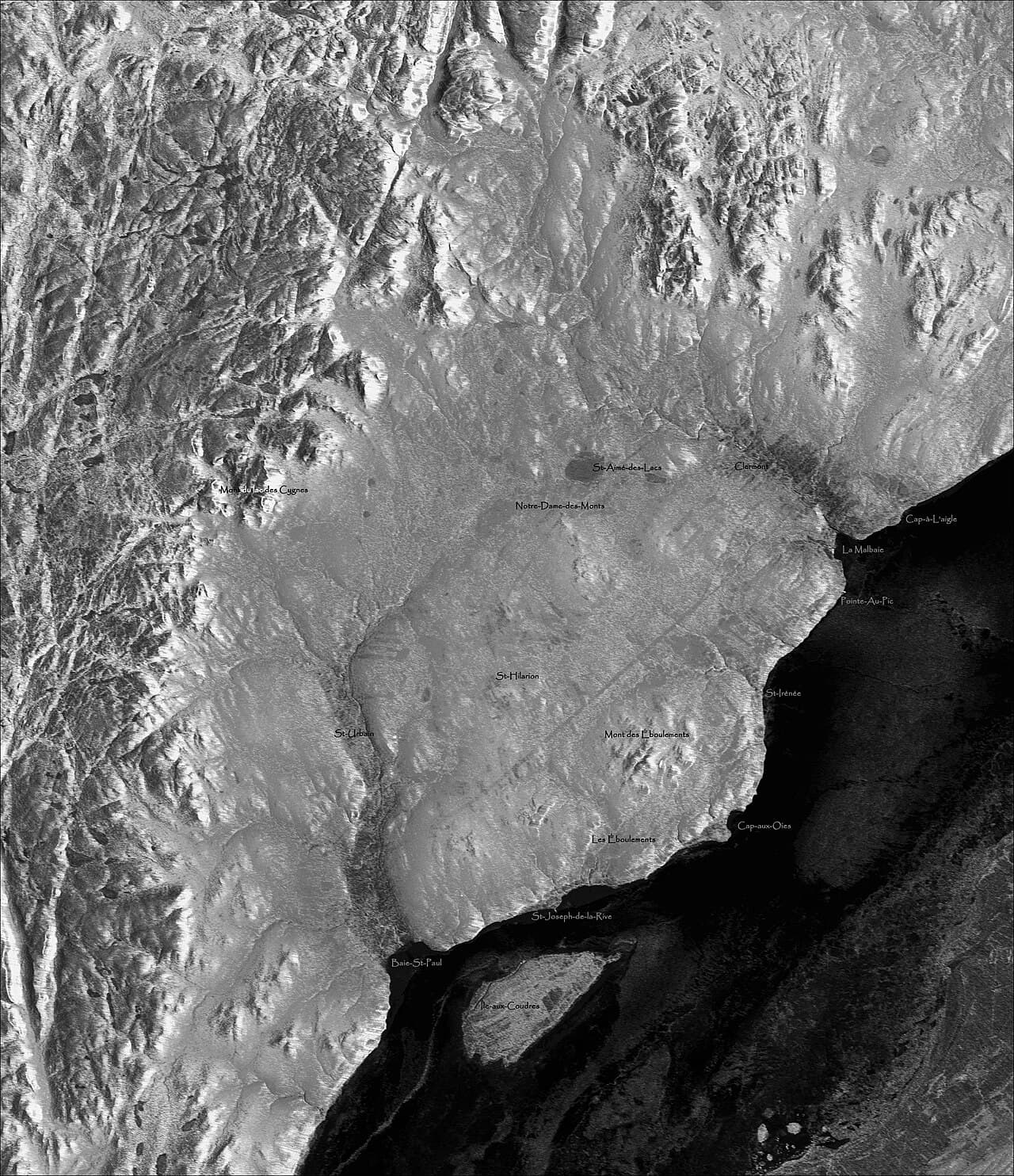
Did you know the region is a crater formed by a giant meteorite? The Astroblème de Charlevoix invites you to celestial and terrestrial explorations:…
Charlevoix is not merely a landscape. It is a crater. Approximately 450 million years ago, a meteorite 2 to 4.5 kilometres in diameter struck what would become this region, releasing energy equivalent to millions of megatonnes of TNT — up to 430 million times the Hiroshima bomb. The impact carved a crater 54 kilometres in diameter, the eleventh-largest identified impact site on Earth and the third-largest in Canada, after Sudbury and Manicouagan.
It is this crater that shaped the valleys, plateaus, and terrain you contemplate from the terrace of our chalet in Cap-à-l'Aigle, La Malbaie. Every mountain, every curve of the river bears the signature of this cosmic event.
The Observatory
The Observatoire de l'Astroblème de Charlevoix, located at 595 Côte Bellevue in La Malbaie, offers a deep dive into this geological and celestial history. Activities unfold across three areas:
Guided visits — Guides lead visitors through a scientific discovery of the site, its impact geology, and its natural heritage. You learn to recognize shatter cones in the rock — those characteristic fracture patterns that allowed geologist Jehan Rondot to identify the crater's meteoritic origin in 1966.
Astronomy evenings — Telescope observations and astrophotography demonstrations. The Charlevoix sky, relatively free from light pollution, offers remarkable viewing conditions.
Outdoor activities — Guided hikes along the St. Lawrence and exploration of the region's natural and traditional heritage. The site is based on a historic seigneurial property and interpretation centre.
A place of knowledge
The observatory collaborates with the Centre d'études collégiales en Charlevoix and welcomes school groups from preschool through university, with programs aligned to Quebec's curriculum.
The science behind the landscape
Mont des Éboulements, the crater's central peak at 768 metres, is one of the world's best-preserved examples of a complex crater's central uplift. The region is also Canada's most seismically active zone — over 200 earthquakes per year, or one every 1.5 days on average. This seismic activity is linked to geological structures created by the impact, reactivated through the ages.
UNESCO designated Charlevoix as a Biosphere Reserve in 1988, recognizing the exceptional biodiversity resulting from the altitude contrasts created by the crater.
Practical information
The observatory is open daily from June 13 to August 30. In May, September, and October, group visits are available by reservation. Phone: 418-665-7645 (off-season: 418-617-1027).
From the villa in La Malbaie, the observatory is just a few minutes' drive. It is a half-day outing that pairs perfectly with a riverside walk or a visit to the seigneurial mill at Les Éboulements. To discover all regional activities, see our guide to things to do in Charlevoix.
To rent a luxury chalet in La Malbaie (Cap-à-l'Aigle), Charlevoix, discover the Le Littoral chalet with heated pool, sauna and spa. Book your stay online or call 418-476-1442.