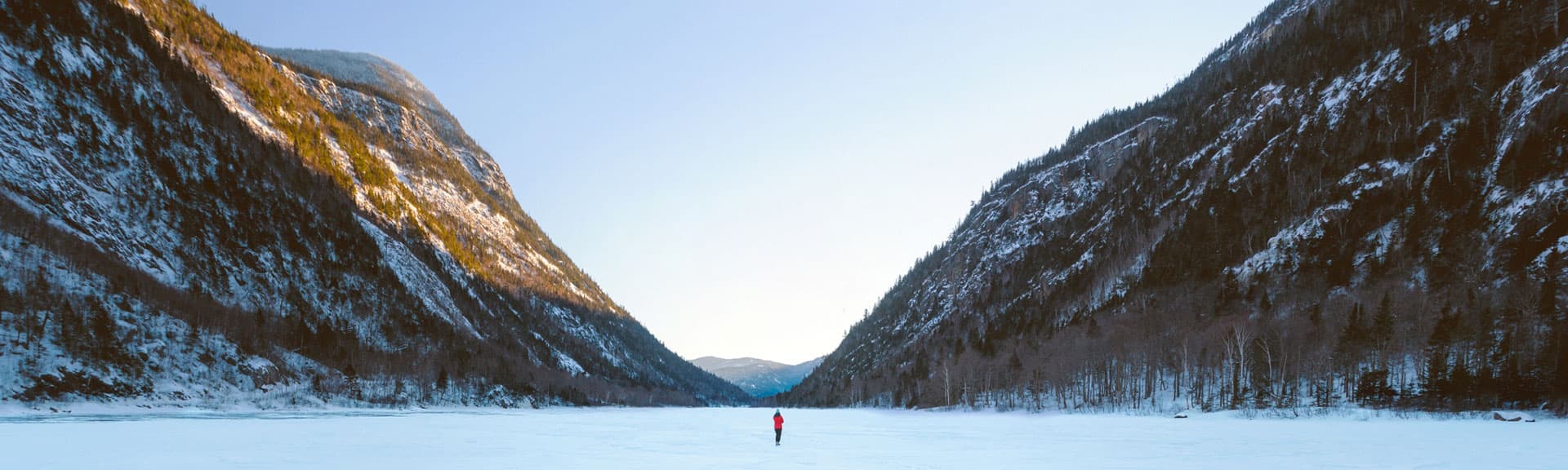
For longer, tougher hikes, the Hautes-Gorges park awaits. Deep valleys, among the highest cliffs east of the Rockies, in the heart of the Charlevoix…
Some landscapes are admired. The Parc national des Hautes-Gorges-de-la-Rivière-Malbaie is earned. Created on June 28, 2000, this 224.9 km² territory in the heart of the Charlevoix Biosphere Reserve (UNESCO, 1988) shelters the highest rock faces east of the Canadian Rockies. This is not tourist hyperbole — it is geological fact.
Superlative relief
The Malbaie River valley is hemmed between walls rising over 800 metres. Mont Jérémie, the park's highest point, reaches 1,050 metres elevation, while the lowest point sits at 190 metres at the southeastern boundary. This nearly 900-metre amplitude, concentrated over a relatively modest area, creates a remarkable ecological gradient: sugar maple and American elm forests on the valley floor give way to stunted, tundra-like vegetation on the summits.
The Acropole des Draveurs: the legendary trail
Seven hiking trails cover 32.9 kilometres in the park. But it is the Acropole des Draveurs that built the park's reputation. This 10.5-kilometre trail with 800 metres of elevation gain leads to the summit of Montagne des Érables. The ascent is sustained, sometimes steep, and rewards hikers with a plunging view over the valley that justifies every drop of sweat. It is one of Quebec's finest hikes, without exaggeration.
The trail's name evokes the draveurs — the log drivers who once guided timber down the Rivière Malbaie, a practice that ended in 1985 with the cessation of forestry operations in the park.
On the water
The Rivière Malbaie, with its cascades including one reaching 160 metres, is accessible by canoe and kayak. An 8-kilometre cycling path runs alongside the gorge, offering immersion in the landscape without the effort of the ascent. Personal vehicles are not allowed in the park — shuttle buses handle transport, preserving the site's tranquillity.
Four seasons
The park does not sleep in winter. Cross-country skiing, snowshoeing, and fatbiking take over the snow-covered trails — see our guide to what to do in Charlevoix in winter to plan your winter visit. The contrast between January's white silence and autumn's explosion of colour makes every visit unique. In mid-September, the park becomes the start of the long course of the Ultra-Trail Harricana, which sets off from here towards Mont Grand-Fonds.
Remarkable wildlife
The park hosts fauna reflecting its habitat diversity: Bicknell's thrush and golden eagle on the summits, peregrine falcon and osprey along the cliffs, woodland caribou on isolated plateaus, and Atlantic salmon in the Rivière Malbaie. The harlequin duck, a small colourful bird of the rapids, is a prized sighting.
Practical information
The park is accessed from Saint-Aimé-des-Lacs, approximately forty-five minutes from our chalet in Cap-à-l'Aigle, La Malbaie, Charlevoix. A daily access fee is required — online reservation through the Sépaq website is strongly recommended, especially in summer.
After the effort of the Acropole des Draveurs, the return to your vacation home is a savoured relief. A local's tip: stop on the way at Boulangerie de Comporté for your supper bread.
To rent a luxury chalet in La Malbaie (Cap-à-l'Aigle), Charlevoix, discover the Le Littoral chalet with heated pool, sauna and spa. Book your stay online or call 418-476-1442.